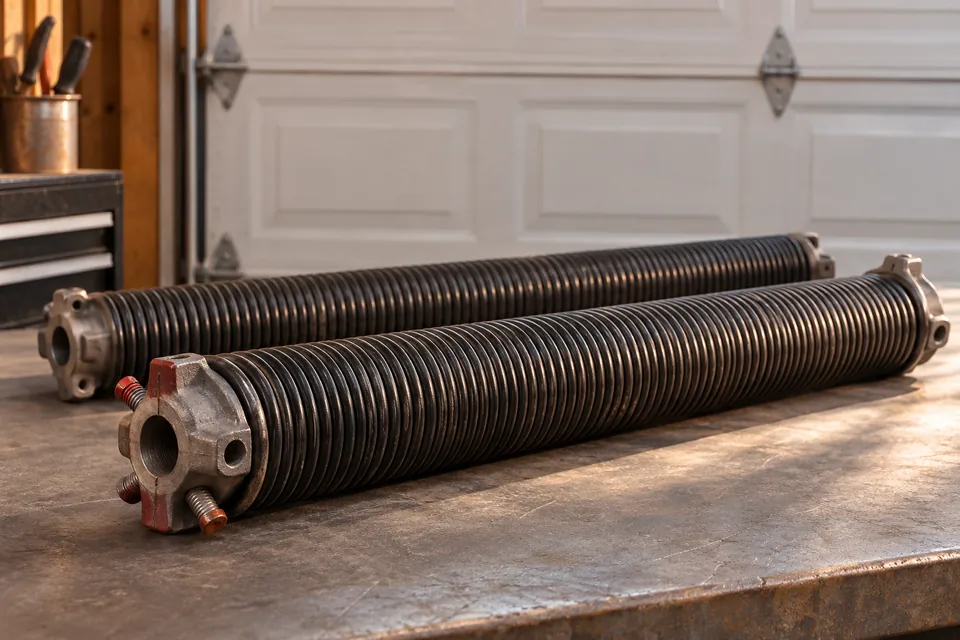
An intact counterbalance may need professional adjustment. A broken spring, damaged cable, unsuitable spring specification, or binding track calls for a different repair decision.
Establish whether adjustment is the right scope
This service concerns evaluating and, when appropriate, adjusting a retained, intact counterbalance. Ask the technician to distinguish incorrect balance from friction, damage, or unsuitable components before proposing work. Clopay explains that incorrect spring tension can strain the opener and places balance correction with a professional.
A failed spring belongs under spring replacement. Replacing one spring architecture with another is spring-system conversion, a separate compatibility proposal rather than a routine balance adjustment.
What the technician needs to establish
Ask for an assessment of the door identification, existing spring arrangement, cables and attachments, track condition, and any evidence of binding or structural damage. The purpose is to determine whether the installed counterbalance can appropriately serve this door. Any physical balance evaluation and adjustment belongs to a qualified technician following the applicable manufacturer instructions.
DASMA warns that spring systems and connected bottom brackets involve dangerous tension. Its damage guidance says an observed problem is a reason to stop inspection and avoid operational testing. If damage is found, ask for the revised repair scope before authorizing an adjustment.
Tell the provider what changed on the door
Added insulation, decorative trim, glazing changes, or a replaced section can matter to the assessment. DASMA explains that door components operate together under defined conditions and that added weight can upset balance, affect the opener, and create other failures.
Share existing paperwork or photographs taken safely from the floor; do not climb or handle tensioned hardware to obtain specifications. Ask whether the original manufacturer permits the alteration and whether the current spring specification remains appropriate. Adjustment alone should not be assumed to compensate for an unapproved modification.
Separate the door result from the opener result
A balance assessment does not establish that the opener is fault-free. Conversely, replacing an opener does not resolve an unsuitable counterbalance. When a separate operator fault remains, use the opener troubleshooting guide to define that work.
Request a written finding: adjustment performed or declined, component concerns, and any further repairs requiring approval. Ask what manufacturer-specific operating and opener-safety verification will follow the mechanical work. Confirm the exact Silver Spring address and door type directly with the provider when discussing the proposed visit.
Questions for a balance-service proposal
- What evidence supports intact-system adjustment rather than spring replacement or another repair?
- Have door alterations and the existing spring specification been considered?
- What findings would stop the adjustment, and what completion checks are included?
Common questions
Do I need to prove the door is unbalanced before contacting someone?
No. Describe prior movement changes, unusual sounds, and known modifications without repeating the movement. Leave physical balance testing to the technician, particularly when the door’s condition is uncertain.
Can an intact-looking spring still be unsuitable?
Appearance does not confirm a correct spring specification or rule out another mechanical fault. The technician needs to assess the retained assembly and any door-weight changes before deciding whether adjustment is appropriate.
Is balancing included whenever an opener is repaired?
Ask for the written scope. Door-balance assessment and operator repair address different parts of the system; the proposal should identify any mechanical correction and the verification planned afterward.
Read a little further.
Sources reviewed November 11, 2026. Follow the manual for your exact door and opener. These resources support general guidance, not a remote inspection.
- Clopay: Garage Door Maintenance Guide Manufacturer guidance connects spring tension and balance to opener strain and assigns balance correction to professionals.
- DASMA TDS 176: Adding Weight to a Garage Door Assembly Explains complete-system design, added-weight effects on balance and opener operation, and manufacturer-specific alteration guidance.
- DASMA TDS 174: Checking a Residential Sectional Garage Door for Damage Observed damage stops inspection and rules out operational testing by the occupant; repair and adjustment require trained technicians.
- DASMA: Garage-door safety tips Spring-system and bottom-bracket tension hazards and the need for model-specific instructions.