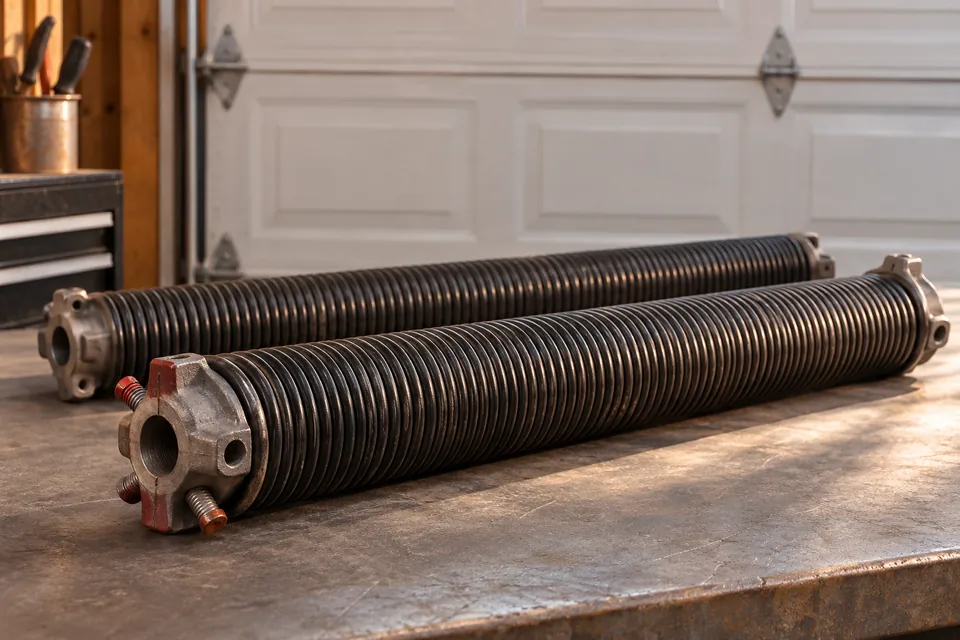
A replacement spring must suit the actual door assembly. A similar-looking spring or a higher opener setting is not a substitute for a matched repair.
A broken spring and an adjustment are different jobs
This page concerns replacing a failed spring while retaining the door. If the spring assembly appears intact and the question is whether the existing system needs professional adjustment, use the door-balance assessment guide. Changing from one spring architecture to another belongs under spring-system conversion.
A bang followed by failed movement is useful history, but it does not establish the entire repair remotely. Tell the provider what happened and where the door stopped. Do not run it again to confirm a suspected break.
Ask how the replacement is matched to this door
DASMA’s spring-life guidance explains that an unsuitable spring can affect counterbalance, operation, and component life. Ask the technician to identify the door and verify the proposed spring parameters against its manufacturer’s requirements.
Share any known change to the door since its last spring replacement: added insulation, decorative material, or a replacement section. Those details may change the assessment. You do not need to measure a loaded spring or climb up to photograph a label.
Make the spring count explicit
A quotation for one spring and a quotation for a pair describe different work. DASMA recommends replacing both springs when a two-spring door has a failed spring. Ask how that guidance applies to the existing assembly and have the parts and quantities written into the estimate.
The inspection should also determine whether connected hardware needs attention. Ask the provider to identify any separate cable, drum, bearing, or attachment concern rather than adding an unexplained hardware package. A visibly crooked door also needs the precautions in the off-track recovery guide.
Compare a specification and warranty, not a promised failure date
Spring cycle life depends on handling, installation, maintenance, use, and environment. A cycle rating is useful product information; it cannot tell you the exact year a spring will fail. Ask which rating is proposed and what the written parts and labor warranty actually covers.
Before authorizing the job, separate the visit charge, spring quantity, related repairs, labor, and total. Ask what professional balance and opener-safety verification will be completed afterward. For a Silver Spring appointment, also confirm the exact address and door type with the provider; a town name alone does not establish availability.
Three details to put in the spring quote
- Which spring specification, quantity, and cycle rating suit this door?
- What connected damage was found, and which additional repairs require approval?
- What is the full total, written warranty, and completion-verification scope?
Common questions
Will a more powerful opener compensate for a broken spring?
The opener does not replace the counterbalance system’s job. Have the spring fault assessed before considering operator replacement or changes to its settings.
Does every spring repair require converting the system?
No. Failed-spring replacement and a change of counterbalance architecture are separate proposals. If conversion is suggested, ask why it is appropriate, what compatibility checks are needed, and how the scope differs.
Should I order a spring using a photograph?
A photograph may help describe the assembly, but appearance alone does not establish the correct specification. Let the technician identify the door requirements without asking you to handle or measure tensioned parts.
Read a little further.
Sources reviewed November 11, 2026. Follow the manual for your exact door and opener. These resources support general guidance, not a remote inspection.
- DASMA: Garage-door safety tips Professional spring work, paired-spring replacement recommendation, and tension-hardware precautions.
- DASMA TDS 190: Factors Affecting Spring Cycle Life Door-specific spring matching and limits of cycle-life expectations.
- Clopay: Garage Door Maintenance Guide Manufacturer guidance places spring replacement and adjustment with a qualified professional; this fault guide does not reproduce movement tests.