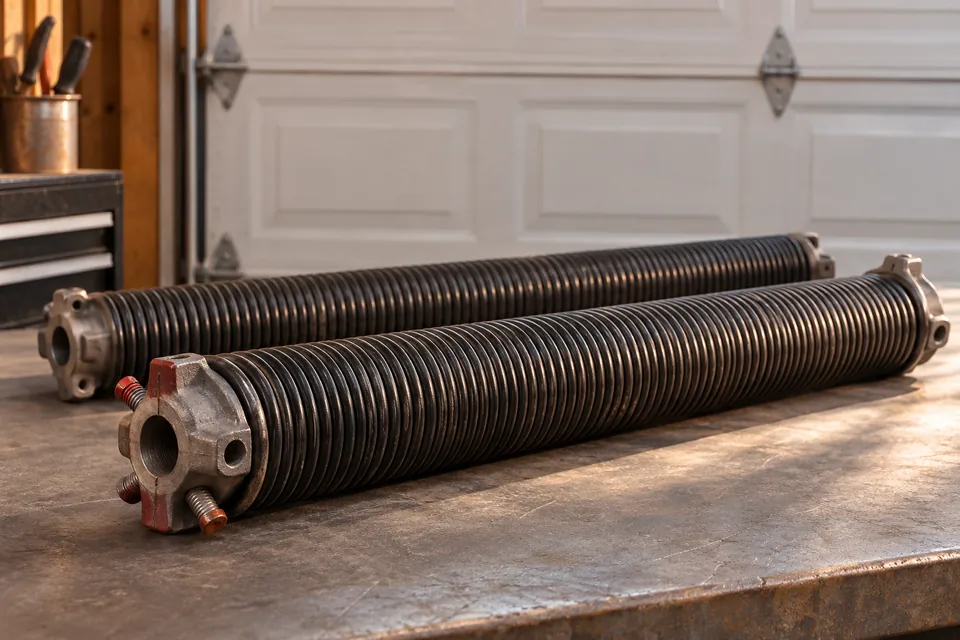
A conversion proposal should explain why the change suits this door, where the new assembly fits and how it will be supported. Torsion is not a universal upgrade for every opening.
Establish why the architecture would change
This service concerns replacing an extension-spring arrangement with a compatible torsion assembly while retaining the door. Ask what practical requirement the conversion addresses and whether retaining the existing architecture is an appropriate alternative. A spring failure alone does not establish that conversion is needed.
For replacement of a failed spring within the existing arrangement, see spring repair. For professional evaluation or adjustment of a retained, intact counterbalance, see door-balance assessment. Have the provider identify which of these jobs is actually proposed.
Available space must suit the complete configuration
The assessment should identify the door model, size, construction, present track arrangement and any added materials. Ask the provider to establish the door's weight requirements and manufacturer-supported counterbalance configuration.
Clopay's insulated-steel manual gives different headroom requirements for extension and torsion systems and for different track radii. Its low-headroom supplement also distinguishes front-mounted torsion, rear-mounted torsion and EZ-SET arrangements, with different hardware requirements. These are specific product instructions, not dimensions that approve every conversion. Ask how ceiling obstructions, side space, track travel and the opener affect the proposed layout.
Specify the load-bearing assembly and its support
Clopay's residential torsion supplement lists a torsion tube, bearing plates, bearings and cable drums alongside the springs. A conversion scope should identify the matched components and say which existing cables, brackets or track parts can remain under the applicable instructions.
The same supplement requires the torsion assembly's anchor pad to connect to the garage's structural frame, rather than drywall or sheetrock. Ask the installer to assess the mounting structure and required preparation. Structural or track changes should be described explicitly before the work is authorized.
Make the finished scope reviewable
Request a written proposal naming the intended spring system, parts, removal of superseded hardware, support work, exclusions and warranty responsibilities. Ask which door and spring instructions govern the design, including any low-headroom supplement. If a choice cannot be confirmed until inspection, have that dependency recorded.
Completion should include professional balance assessment and applicable opener-safety verification under the exact manuals. Ask for the new component details and future maintenance guidance. Confirm the provider's identity, exact-address coverage in Silver Spring and the full project total separately; this guide does not establish availability or a conversion price.
Questions for an extension-to-torsion proposal
- What requirement justifies conversion rather than repair or adjustment?
- Which door-specific instructions support the proposed layout and clearance?
- What mounting structure and matched hardware are required, retained or replaced?
- Which professional completion checks, records and warranty terms are included?
Common questions
Can every extension-spring door be converted to torsion?
Compatibility must be established for the actual door, track, clearance and supporting structure. A provider may need manufacturer input or may recommend retaining the existing arrangement. No universal kit or fit is assumed here.
Does low headroom automatically rule out conversion?
Some manufacturer systems provide specific low-headroom torsion arrangements. Their track, bracket and mounting requirements differ, so their existence does not establish that one fits your door. Ask for a supported configuration after assessment.
Do missing extension-spring safety cables require a torsion conversion?
That is a separate safety concern. DASMA calls for containment cables on extension-spring systems. Ask a professional to assess the retained arrangement; missing containment alone does not prove a conversion is necessary.
Read a little further.
Sources reviewed November 11, 2026. Follow the manual for your exact door and opener. These resources support general guidance, not a remote inspection.
- Clopay: Insulated Steel Residential Garage Door Instructions Defines spring and track-dependent clearance and separate low-headroom options for the covered residential doors.
- Clopay: Single Track Low Headroom Supplemental Instructions Distinguishes configuration-specific clearance and hardware for extension, front/rear torsion and EZ-SET systems; used as evidence of design differences, not universal retrofit approval.
- Clopay: Residential Torsion Spring Installation Supplement Identifies torsion assembly components and structural-frame attachment of the anchor pad. Installation and winding procedures are not reproduced.
- DASMA: Garage Door Safety Tips Supports professional spring-system work, tension-hardware precautions and extension-spring containment cables.