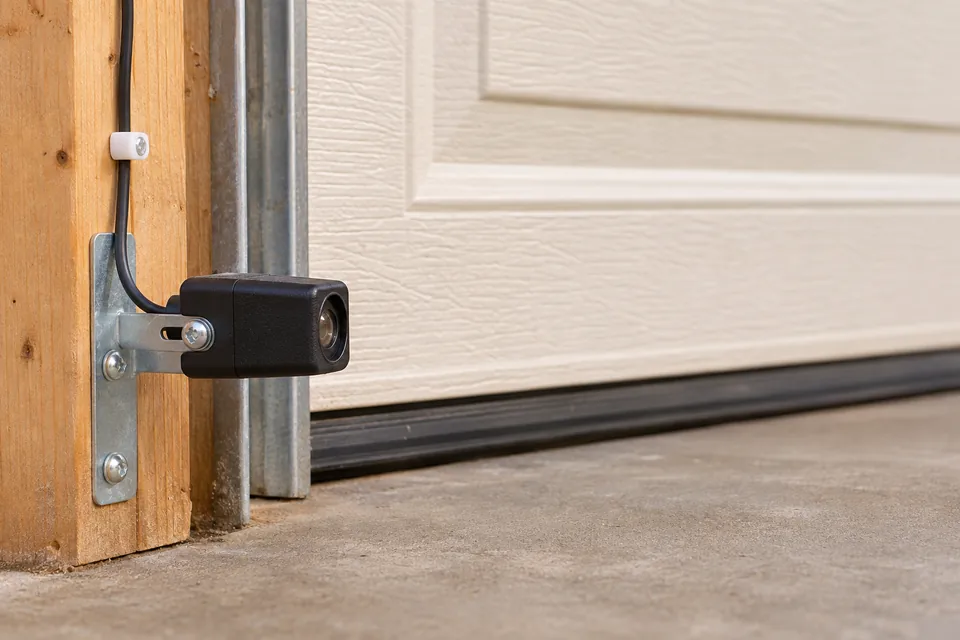
A refusal to close is a symptom. Record what happened during normal use, then let an assessment separate an obstruction, control issue, safety-device fault and mechanical resistance.
Where did the closing sequence change?
Use the last ordinary operation you already witnessed. Did the door stay fully open without moving, reverse while descending, or reach the floor and rise again? Tell the provider whether this began suddenly, followed an impact, or appeared after other work. None of these observations identifies a failed part by itself.
Describe the current position without recreating the event. You do not need another cycle, a ladder or a hand on the door to prepare a useful account. If a vehicle remains inside, keep its engine off and use another safe entrance.
Put mechanical warning signs ahead of indicator lights
A visible loose cable, crooked section or damaged track changes the safety question. DASMA warns that spring-connected cables and bottom brackets involve dangerous tension and require trained personnel. An illuminated sensor does not make a damaged door safe to move.
If a roller has left its track or the door is hanging unevenly, use the off-track recovery guide. That situation needs controlled recovery and an assessment of supporting components, rather than routine closing adjustments.
Describe the indication in the opener’s own terms
Chamberlain’s support information identifies more than one explanation for a flashing opener light, including its safety-sensor circuit and, on applicable controls, the lock function. Its diagnostic displays also vary by model. Share the make, model and exact indication already observed, rather than calling every flash a bad sensor.
Genie likewise directs owners with a persistent Safe-T-Beam indication to the correct manual. A provider can examine the relevant obstruction, alignment or wiring possibilities under that model’s instructions. This page does not reproduce an adjustment sequence or a sensor-defeat workaround.
Questions for a closing-fault assessment
- What finding explains this particular stopping or reversal pattern?
- Does the proposal address a door-system problem, a safety-device circuit, or the operator?
- Which diagnostic charges and model-specific completion checks are included?
Common questions
Does a door that reverses always need new safety sensors?
No. A closing symptom alone does not establish a failed sensor. The assessment needs to consider the observed sequence, mechanical condition and model-specific indications before selecting a repair.
Should I repeat the problem so I can count the flashes?
Use indications you already observed. Do not run a suspect or damaged door again to collect information. An unknown flash count can be left for the technician.
Is this the same service as sensor replacement?
This guide starts with an unknown cause. Sensor replacement is a narrower scope after assessment identifies a compatible sensor or circuit repair as necessary.
Read a little further.
Sources reviewed November 11, 2026. Follow the manual for your exact door and opener. These resources support general guidance, not a remote inspection.
- Chamberlain: opener light blinks but the door won’t close Explains multiple causes and model-dependent diagnostic displays. Its operation and adjustment procedures are not reproduced here.
- DASMA: garage-door safety tips Supports professional handling of spring-connected cables and bottom brackets; consult the exact door and opener manuals.
- Genie: Safe-T-Beam indicator guidance Manufacturer-specific information, updated June 24, 2026. Its light description is not a universal code for other systems.