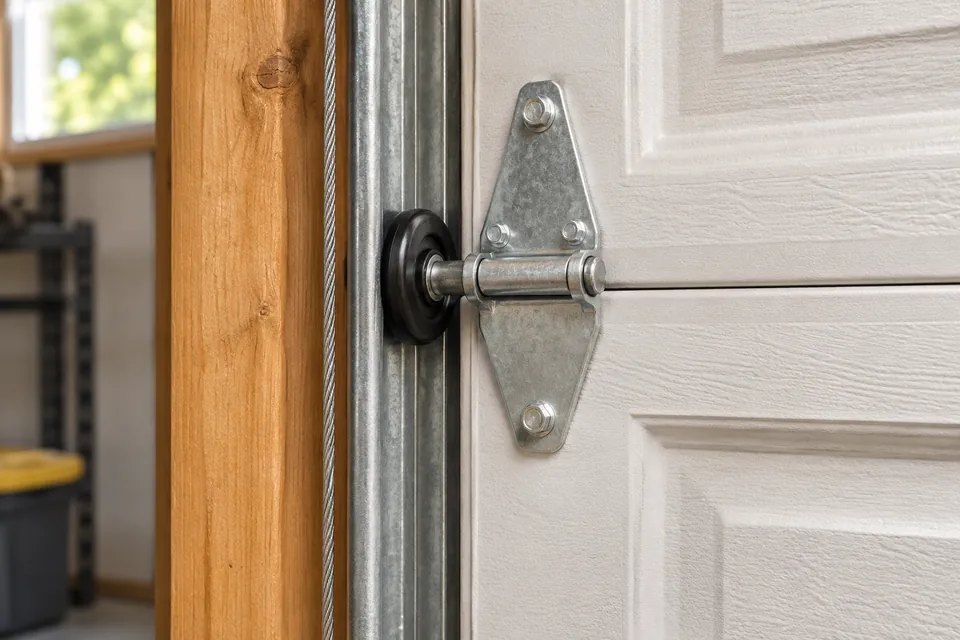
Putting a roller back into a rail is not a complete repair when the door, supports or lifting system may also be damaged.
Recovery comes before routine rail work
This page concerns a door that has lost its normal support or alignment. That differs from a retained door whose rails need track repair and alignment. A raised door alone is not evidence of derailment; describe the visible displacement or damage rather than assigning a diagnosis.
DASMA advises stopping an inspection when damage is observed and avoiding an operating test. There is no need to reproduce the incident, check whether the opener can pull harder or find out how far the door will travel.
Describe the position from outside the hazard
Tell the provider whether the door is closed, partly raised or open, and whether a section hangs unevenly. Mention an impact, a bang or a loose cable only if you already noticed it. Do not approach the hardware or climb to obtain photographs.
For a Silver Spring address, explain whether another entrance is usable and whether access is shared. Confirm the provider handles a derailed residential sectional door and serves the exact property. The website does not establish those arrangements.
Ask for the cause as well as the recovery
Ask how the proposed scope separates controlled recovery from correction of the underlying fault. The assessment may need to consider rollers, rails, their attachments, door sections and the counterbalance system. Deformed components can make continued operation questionable.
A hanging cable is information for the technician, not a part to reconnect. The lift-cable replacement guide covers that separate component scope. Bent rails and damaged sections also need individual decisions; a door being upright again does not establish that every part is serviceable.
Questions specific to a derailed door
- What damage or support failure caused the door to leave its normal path?
- Which charges cover securing the door, and which cover permanent corrective work?
- Which components will be retained, replaced and verified before the door is used again?
Common questions
Can I close it first to protect the garage?
Do not try to move a visibly derailed or unsupported door. Keep clear and tell the provider that securing the opening is a concern. A technician must assess its condition before deciding how to handle it.
Does every off-track door need new tracks?
That cannot be determined from the symptom alone. The technician should assess rail deformation, attachments and the rest of the door system, then explain the parts proposed. Repositioning a roller alone may leave the original fault unresolved.
Is a new opener the solution?
An opener replacement does not resolve a door that has lost normal support. Have the mechanical condition assessed first; any operator damage is a separate part of the scope.
Read a little further.
Sources reviewed November 11, 2026. Follow the manual for your exact door and opener. These resources support general guidance, not a remote inspection.
- DASMA TDS 174: Checking a Residential Sectional Garage Door for Damage Damage warnings, no operational inspection after observed damage, and concerns about deformed components and supporting framing.
- DASMA garage-door safety tips High-tension cables and bottom brackets require trained technicians; track and sections form a matched system.
- Clopay garage-door maintenance guide Identifies tracks and door sections as professional repair scopes and recommends assessment before continued use of a damaged door. Routine maintenance steps are not instructions for a derailed door.