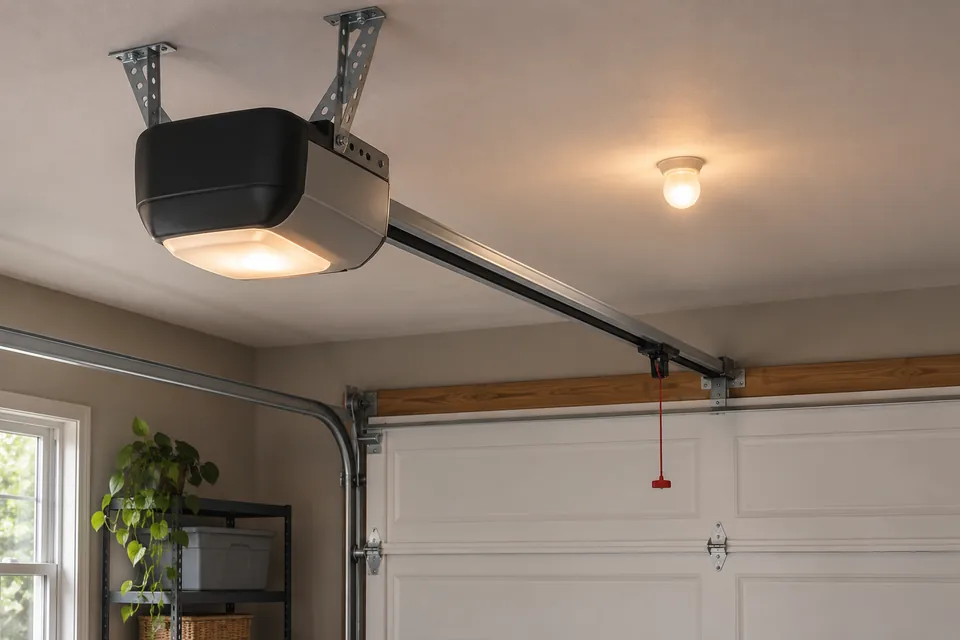
This service concerns the backup battery serving the operator, rather than a remote-control coin cell. A warning sound alone does not establish that the battery needs replacement.
Match the replacement to the existing backup system
Share the opener model and any separate backup-unit identification from paperwork or a safely readable label. Do not climb to collect it. The provider should verify backup capability and the manufacturer-approved replacement against the exact equipment documentation.
Battery-only replacement and backup hardware are different purchases. Genie, for example, lists its replacement battery separately from model-specific backup hardware. Similar dimensions or voltage do not establish compatibility. If the opener lacks a supported backup option, discuss new opener installation; replacing a battery cannot add that capability.
Bring the warning history, without recreating it
Record a sound or indicator you already noticed, whether household power was interrupted, and any known installation history. Indicator meanings and replacement criteria belong to the particular manual; there is no universal beep code or battery replacement age.
Ask the technician to distinguish a depleted battery from a charging, connection or other operator fault. Do not open the housing, repeatedly cycle the door or disconnect power to reproduce a symptom. An unresolved movement problem belongs under opener troubleshooting and repair.
Specify the part and charging verification
The proposal should identify the approved battery part, installation labor, assessment of the battery enclosure and connections, and any separate repair requiring approval. Genie cautions against batteries it has not supplied and requires isolation from all power sources before service; the qualified provider should follow the applicable manual.
Ask how correct charging and battery operation will be verified after the required charge period. Avoid improvised chargers or battery-chemistry substitutions. Keep the part details, service record and applicable warranty terms with the operator manual.
Know what remains available during an outage
Have the provider explain your model's battery-mode limits, charging needs and permitted readiness checks on a safe door. Genie notes that battery endurance varies with conditions and use, and some functions change under backup power. Do not assume normal speed, lighting or a guaranteed number of movements.
Discuss an accessible alternative entrance and outage precautions before relying on the garage as the only route. A battery does not correct door resistance or a balance fault. DASMA explains that openers require properly balanced doors.
Agree who takes the old battery
Include removal and appropriate recycling or disposal in the work agreement. Montgomery County directs residents to keep batteries out of regular trash and recycling and identifies its Household Hazardous Waste drop-off for home-generated batteries. Business waste follows separate arrangements, so ask which route the contractor will use rather than assuming resident drop-off rules cover collected service waste.
Questions before authorizing a battery replacement
- Which opener and backup-unit model establish the approved battery part?
- What finding supports replacement, and are any charging-system repairs separate?
- How are charge readiness, model-specific operation and old-battery disposal documented?
Common questions
Can a backup battery be added to any older opener?
No. Manufacturer support depends on the model. Some operators accept a specified backup accessory; others do not. Have compatibility confirmed before buying equipment, and treat a new backup installation as a separate scope from replacing an existing battery.
Does beeping mean the backup battery has failed?
Not by itself. Have the observed pattern interpreted using the exact model's documentation. Report what you already heard and whether an outage occurred; do not create repeated test cycles to obtain a code.
Should every backup battery be replaced at the same age?
No. Follow the equipment's guidance and assessed condition. Genie identifies environmental conditions and frequency of use as factors affecting battery life, so a single lifespan should not be applied to every opener.
Read a little further.
Sources reviewed November 11, 2026. Follow the manual for your exact door and opener. These resources support general guidance, not a remote inspection.
- The Genie Company: Backup replacement battery 111658.0002.S Manufacturer listing distinguishes a battery-only part for identified models from separately sold backup hardware. It is not a universal fitment list.
- The Genie Company: Battery backup product and FAQs Supports model-dependent backup options, approved batteries and condition-dependent performance. California requirements are not applied to Maryland.
- The Genie Company: Battery replacement instructions 111658.0002.S Documents electrical and battery isolation and a charging period before testing this battery. Hardware removal and door-disconnection procedures are left to the qualified provider.
- DASMA: Safety tips for garage door openers Supports exact-manual guidance and professional assessment of a door that is not properly balanced; no homeowner movement tests are reproduced.
- Montgomery County: How to recycle or dispose of batteries Directs batteries away from regular trash and recycling and distinguishes home-generated battery drop-off from business disposal arrangements.