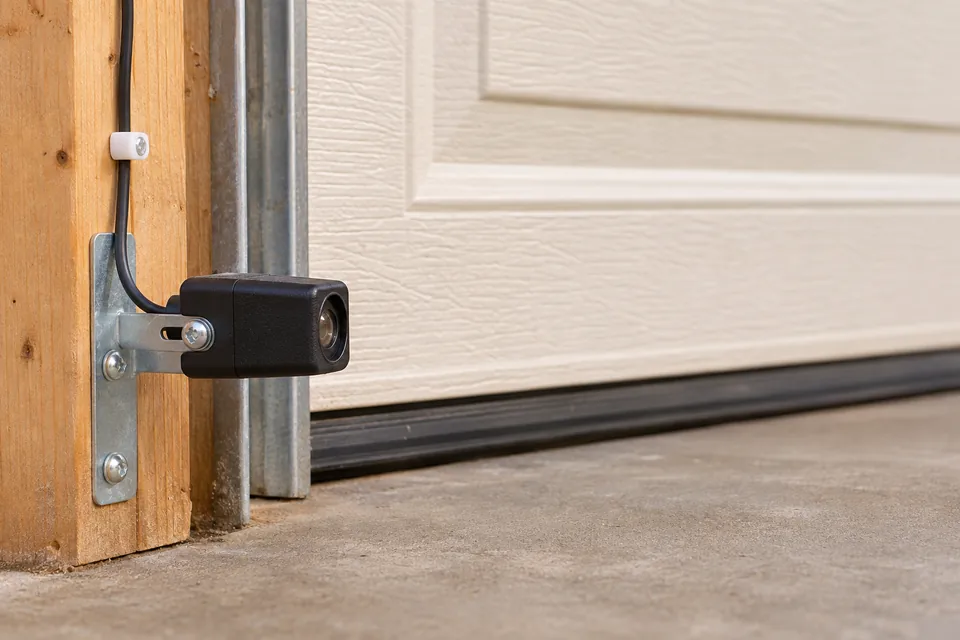
Ask for separate findings on contact reversal, the installed secondary protection, controls and warning labels. A completed operating cycle alone does not document these checks.
Choose a safety evaluation with a clear boundary
This visit focuses on entrapment protection, controls and comparison with the identified opener's instructions. It differs from preventive maintenance, which plans lubrication and condition-led care for an otherwise operating door. Confirm whether a proposed tune-up includes safety verification.
If the immediate complaint is an unexplained refusal to descend, start with door-won't-close diagnosis. A safety inspection need not establish every cause of a closing problem.
Identify both the opener and its protection features
Share an existing manual, receipt or accessible model photograph. Leave elevated labels to the technician. The provider should identify the door type, opener model, fitted protection devices and applicable instructions before deciding which checks apply.
Photo-eye protection and contact reversal need separate findings. The official LiftMaster manual for models 8550W, 8557W and 8550WL, for example, lists separate checks for the safety reversal system and its Protector System. A visible sensor does not establish that both were verified. If a sensor-circuit defect is confirmed, safety-sensor repair covers that narrower corrective work.
Include the controls and installation details
Ask the technician to compare wall-control placement, warning labels, manual-release provision and relevant attachments with the model's instructions. The LiftMaster manual cited here requires its wall control to be within sight of the door, away from moving parts and at least five feet above adjacent walking surfaces. It also specifies warning-label placement.
Discuss any added timer or unattended-close accessory so the provider can check its permitted use with the actual door and operator. Record missing manuals or unidentified accessories for follow-up.
Mechanical concerns can postpone active checks
DASMA's inspection checklist connects effective entrapment protection with a balanced door and an effectively working operator. It notes that door-system servicing may be needed before contact-reversal testing. A crooked door, damaged hardware or other concerning condition should therefore change the inspection sequence.
Ask which checks must wait for corrective work. Physical movement, release, measurement and test procedures belong to the qualified provider under the exact manual. Prepare observations from ordinary use without running another cycle.
Leave with results and a next decision
Request dated findings identifying the equipment, manual used, checks completed, results, deferred checks and reasons. Separate proposed repairs from completed corrections and their verification. Ask what needs attention before further operation.
CPSC identifies 16 CFR Part 1211 as the mandatory product safety standard for automatic residential garage-door operators. A service inspection report should state its actual scope; it is not a product-certification document or a guarantee of future performance. Confirm address coverage, charges and additional-work authorization with the provider.
What the written inspection should identify
- Door and opener models, protection devices and the instructions used.
- Separate reversal, secondary-protection, control and label findings.
- Checks deferred because conditions or equipment details were uncertain.
- Required corrections, completed verification and remaining limitations.
Common questions
Does seeing two photo-eyes mean the system passes?
No. Presence is only one observation. Ask the technician to document the installed protection's condition and manufacturer-specific verification separately from contact reversal and control checks.
Should I test a suspect opener before the inspection?
Do not recreate the fault. Provide what you already observed and leave the door undisturbed if its condition is uncertain. The technician should establish safe conditions and follow the identified manual.
What if the report recommends repair before testing?
Ask which condition prevents a safe or meaningful check and which verification remains incomplete. Authorize corrective work separately and request the deferred results after the system is safe for professional checking.
Read a little further.
Sources reviewed November 11, 2026. Follow the manual for your exact door and opener. These resources support general guidance, not a remote inspection.
- DASMA TDS 167: Residential Sectional Garage Door and Electric Operator Checklist Separates door, control, photo-eye and contact-reversal findings; identifies conditions that can require servicing before testing.
- LiftMaster: 8550W, 8557W and 8550WL owner's manual, document 114A5017 Model-specific example covering separate protection checks, control placement, labels and restrictions on unattended-close features. Procedures are not reproduced.
- CPSC: Automatic Residential Garage Door Operators Identifies the mandatory product standard and product-certification requirements; does not describe a service-visit certification.