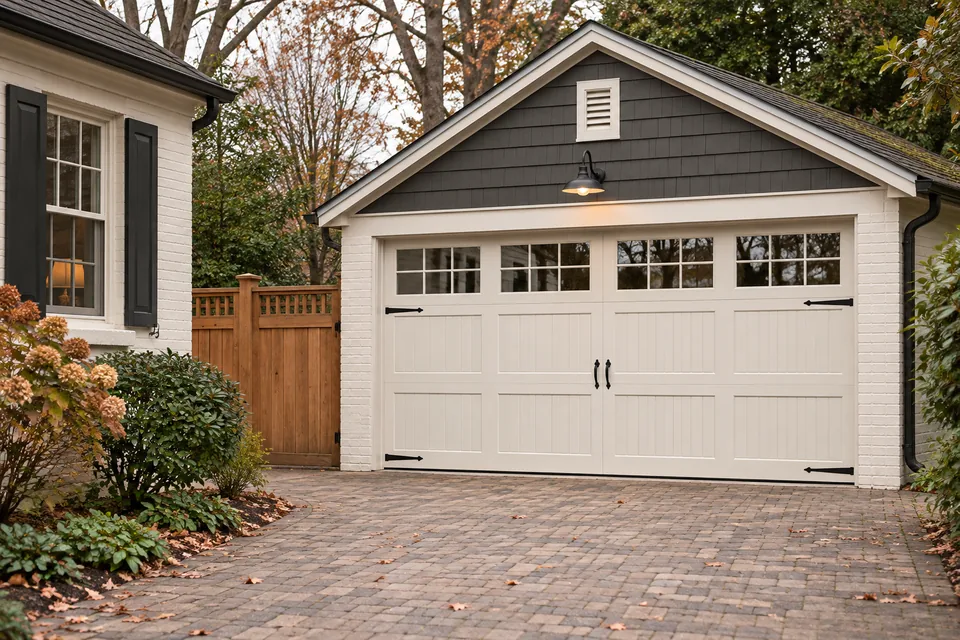
Section replacement retains the rest of the door. Matching its appearance is only part of the job; the replacement must also work with the assembly’s joints, hardware and performance requirements.
Name the part before comparing proposals
People often call both a full horizontal door section and its decorative face a “panel.” Ask the provider to identify exactly what the estimate replaces: a complete moving section, a cosmetic element, or another part.
This guide concerns a matched section within a retained door. A proposal to remove the complete assembly belongs under complete door replacement. If the damage is confined to a window or insert, ask whether window replacement is possible for that model before approving an entire section.
A similar pattern does not establish a match
Clopay’s ordering guidance uses the door model, section size, color and section position to identify a replacement. Share an existing invoice or safely available model information; do not climb beside a damaged door or reach around its hardware to obtain a label.
DASMA cautions that similar-looking components may differ in strength and function. Ask how the provider will verify the replacement against the original manufacturer’s specifications. Matching width or a raised-panel pattern alone does not establish compatibility. Availability must be checked for the actual model, including discontinued or custom designs.
An impact can change more than the visible surface
Tell the provider what struck the door, which area was affected and whether uneven movement had already occurred. Do not create a new movement test. Deformation of sections, tracks or hardware can make operation questionable, according to DASMA’s damage guidance.
Ask which adjoining sections, connections and supporting parts were assessed. A proposed reinforcement strut needs its own manufacturer-supported purpose; it is not an automatic substitute for a structurally sound section. A crooked or unsupported door requires off-track recovery precautions before a cosmetic repair discussion.
Make the retained-door option understandable
Request the exact section and quantity, related hardware, labor, disposal and total charge in writing. Ask how the proposed finish will compare with the retained door and whether any additional finishing is included. Do not treat a matching color name as a promise of an invisible repair.
If a new door is also proposed, compare the reason and scope of each option rather than assuming either is always cheaper. Ask what professional checks will establish balance, travel and opener-safety operation after section work, plus the parts and labor warranty. For a Silver Spring visit, confirm the actual address, door type and visit charge directly with the provider.
Before agreeing to a section order
- Which exact section is being replaced, and how was its compatibility verified?
- What adjoining damage and finish differences are included in the proposal?
- What is the complete total, warranty and professional completion-verification scope?
Common questions
Can a section from another door with the same pattern be used?
Appearance alone is insufficient. The provider should verify the proposed component against the original assembly’s requirements and consult the manufacturer when compatibility is uncertain.
Does a damaged bottom section mean only cosmetic work?
No. Its condition and connected hardware need professional assessment. Do not loosen its fixtures or try to remove it; some attachments connect with the loaded counterbalance system.
Does the door’s age decide whether to replace everything?
Age can inform the discussion, but condition, compatible-part availability, connected damage and the written alternatives matter. This guide does not use a universal age cutoff.
Read a little further.
Sources reviewed November 11, 2026. Follow the manual for your exact door and opener. These resources support general guidance, not a remote inspection.
- Clopay: Can I Replace My Garage Door Panels? Model, section position, size and color help identify replacement sections. DIY removal steps, universal age thresholds and national price claims are not reproduced here.
- DASMA TDS 183: Garage Door Component Substitution Similar appearance does not establish strength, function or certified-assembly compatibility; consult the original manufacturer when uncertain.
- DASMA TDS 174: Checking a Residential Sectional Garage Door for Damage Deformation can make operability questionable. Stop after observed damage rather than proceeding to an operating test.
- DASMA: Garage Door Systems safety tips Trained-technician precautions for loaded bottom brackets and matched track/section systems.