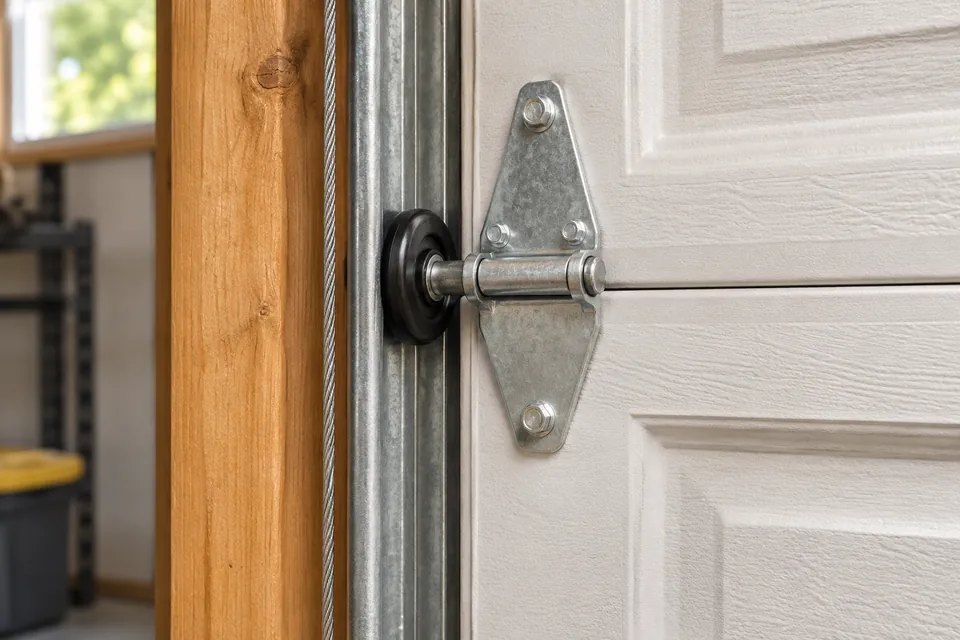
Reinforcement belongs on a suitable retained assembly using the door manufacturer's specifications. The assessment must include the attachment material, added weight, counterbalance and support.
Separate the strut from the opener connection
A horizontal strut reinforces a door section; the bracket connecting a drawbar opener to the door has its own structural role. DASMA directs installers to follow the manufacturer's top-section reinforcement instructions and provide an adequate operator attachment. One part does not automatically replace the other.
Ask whether the proposal addresses missing specified reinforcement, an approved retrofit or the opener connection. Installing an entire new operator is a separate opener-installation scope.
Establish whether the section can be retained
Visible bending does not establish that a strut can rescue the section. The provider should assess the section material, joints and attachment areas and explain whether the manufacturer permits the proposed work. DASMA treats deformed panels or hardware as reasons for professional assessment before operation.
Compare matched section replacement if the section is damaged. If the assembly cannot reasonably be retained, request a separate complete door replacement proposal rather than treating reinforcement as a structural cure.
The door model determines the reinforcement plan
Clopay's parts catalog lists multiple strut profiles and sizes, plus distinct operator reinforcement kits and brackets. Those choices illustrate why door width alone is insufficient to select a universal part.
Provide model information from existing paperwork when available. Ask the provider to identify the applicable manufacturer instructions, reinforcement type, quantity, placement and fastening requirements. Have the technician obtain information that would require climbing or moving a questionable door; do not remove hardware to identify it.
Include the weight beyond the new bar
DASMA warns that added weight can upset spring balance and overload the opener. A reinforcement change may also require suitable springs, hardware and supporting track. Ask how the proposal accounts for the completed door's weight and the condition and capacity of its supports.
Any necessary balance assessment and counterbalance work belong to a qualified provider. Request professional verification of clearance, travel and opener safety under the applicable manuals after the work.
Describe the result without assuming a wind upgrade
An added strut does not by itself establish a higher wind rating. Wind performance depends on the specified assembly and its attachment to the building; ask for manufacturer documentation if a wind-resistance improvement is claimed.
The written scope should identify the approved parts, related support work, completion checks and warranty terms. For a Silver Spring property, confirm the exact address, door type and assessment charge directly with the provider before arranging work.
Before approving reinforcement
- What manufacturer instructions authorize this work on this door model?
- Are the section and attachment areas suitable to retain?
- Which struts, opener brackets and related support changes are included?
- How will added weight, balance and professional completion checks be addressed?
Common questions
Can a strut repair every sagging or cracked section?
No. A technician must assess the section and its connections. Reinforcement should have a manufacturer-supported purpose; damaged material may require a matched replacement section or a different assembly-level solution.
Does a top strut make an opener reinforcement bracket unnecessary?
Do not assume that. The horizontal reinforcement and operator connection have distinct roles. The door and opener instructions determine the required arrangement for that assembly.
Will adding reinforcement always require new springs?
There is no universal answer. Added weight changes the assessment. Have the provider determine the appropriate counterbalance and supporting components under the manufacturer's requirements and itemize any necessary changes.
Read a little further.
Sources reviewed November 11, 2026. Follow the manual for your exact door and opener. These resources support general guidance, not a remote inspection.
- DASMA TDS 166: Connecting a Drawbar Operator to a Sectional Garage Door Top-section reinforcement, structurally adequate operator attachments and supporting structures must follow the applicable manufacturer instructions. Installation procedures are not reproduced.
- Clopay: Residential and Commercial Doors Parts and Accessories, RP26–RP27 Manufacturer catalog distinguishes strut profiles, sizes and operator reinforcement kits. Catalog prices are not used as local installed prices.
- DASMA TDS 176: Adding Weight to a Garage Door Assembly Explains system-level consequences of added weight for balance, opener load, track and other components.
- DASMA TDS 152: Garage Doors and High Wind Events Reinforcement can require an appropriate package of springs, hardware and supporting track; door and building attachments matter to wind performance.
- DASMA TDS 174: Checking a Residential Sectional Garage Door for Damage Deformed sections or hardware warrant professional assessment; observed damage precludes an operating inspection. Reader movement tests are not reproduced.