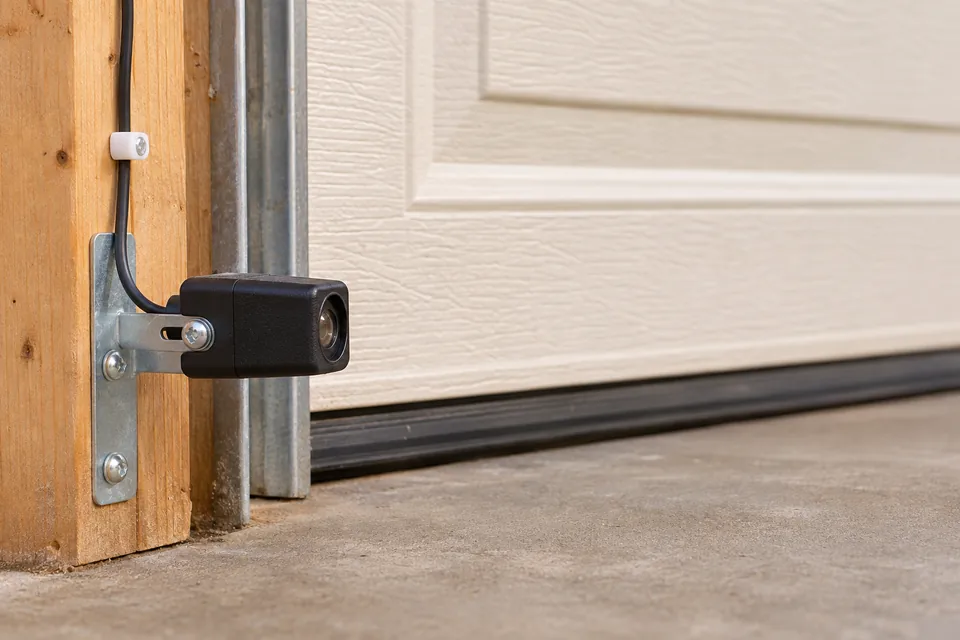
Ask which part of the sensor circuit failed, which replacement is approved for the opener model, and how the technician will verify the restored protection.
Start with the confirmed circuit finding
This scope begins after assessment points to a photo-eye or its circuit. If all you know is that the door reverses or refuses to descend, start with door-won’t-close diagnosis. That service considers the closing complaint before choosing a component.
For a sensor repair proposal, ask whether the finding concerns a damaged unit, mounting position, an interrupted sight line, wiring or connections. Genie’s replacement instructions identify alignment, obstruction and pinched or broken wire as distinct possibilities. An indicator seen during ordinary use is useful context; its color alone is not a parts diagnosis.
Compatibility needs the complete opener model
Provide an existing manual, receipt or safely accessible photograph of the model label. Do not climb to obtain it. Ask the provider to identify the approved sensor assembly and any required connectors before ordering parts; similar housings do not establish interchangeability.
There can be exceptions within one brand. Genie’s 37220R product page describes compatibility with many Genie openers using required safety beams, but explicitly excludes models 2040 and 2040L. This is a reason to check the exact model, rather than a recommendation of that kit for your door. The same listing includes mounting hardware but excludes bell wire.
Specify what happens beyond replacing the eyes
A written scope should say whether existing sensor mounts and wiring will be retained, repaired or replaced. Ask how a visibly damaged mount or wire affects the proposed work, and whether access or concealed routing changes the estimate. Physical alignment, electrical isolation and connection work belong to the technician following the correct instructions.
Genie’s replacement instructions address the sight line, mounting location and wire condition separately. Ask which finding makes new parts necessary. If assessment instead identifies an operator fault outside the sensor circuit, request an explanation through opener troubleshooting and repair before expanding authorization.
Completion includes documented safety verification
Ask the technician to record the installed part number, corrected defect and applicable manufacturer safety checks once the door is safe for professional verification. A steady lamp by itself is not a written account of completed safety checks. Do not perform an active-door test to prepare for the visit.
Genie warns against disabling or modifying its Safe-T-Beam system. DASMA also emphasizes that safety instructions differ by model. For a broader review of entrapment protection and controls, discuss a separate opener safety inspection. Confirm exact-address coverage, availability, diagnostic charges and the proposed repair scope directly with the provider.
Questions before authorizing sensor work
- What finding identifies the photo-eye circuit rather than another closing fault?
- Which part number is approved for this complete opener model?
- Does the scope include mounts, connectors and any necessary wire replacement?
- Which manufacturer checks and parts warranty will be documented at completion?
Common questions
Can a working sensor pair be retained if the wiring is damaged?
Ask the technician to separate the condition of the units from the wire and connection findings. The proposal should explain whether circuit repair is sufficient or a compatible replacement assembly is also needed. Do not handle the wiring yourself.
Are replacement photo-eyes universal?
Do not assume that. Manufacturer compatibility restrictions can include exceptions within the same brand. Ask for a part number checked against your opener’s complete model and its applicable instructions.
Does sensor repair include a complete opener safety inspection?
Confirm the scope. Verification of the repaired circuit should be explained, while a broader inspection of entrapment protection and controls may be separately proposed. Ask which checks the technician will record.
Read a little further.
Sources reviewed November 11, 2026. Follow the manual for your exact door and opener. These resources support general guidance, not a remote inspection.
- Genie: 37220R Safe-T-Beam replacement sensors Product body states compatibility restrictions, excludes 2040/2040L and says bell wire is not included. No price or availability claim is used.
- Genie: replacement Safe-T-Beam installation instructions Component-specific instructions distinguish mounting, sight line, wiring and professional completion checks. Wiring, adjustment and active-door procedures are not reproduced.
- Genie: can Safe-T-Beam be disabled or removed? Manufacturer warning against tampering with, removing, unwiring or modifying its safety system.
- DASMA: garage-door safety tips Directs readers to model-specific safety instructions and trained technicians for hazardous door-system work.