Containment cables address a specific extension-spring hazard. They do not replace lifting cables, repair a broken spring or establish that the rest of the door is safe.
Name the cable by its job
DASMA explains that extension springs need safety cables to help contain a broken spring and calls for a dealer safety inspection when they are absent. This page concerns adding or replacing that containment on an existing extension-spring door.
The load-bearing cables connecting the counterbalance to the door have another job. Frayed, loose or displaced lifting cables belong to lift-cable repair. Ask the provider to name both cable types clearly; a proposal saying only “cable replacement” leaves the scope uncertain.
Confirm that the retained system uses extension springs
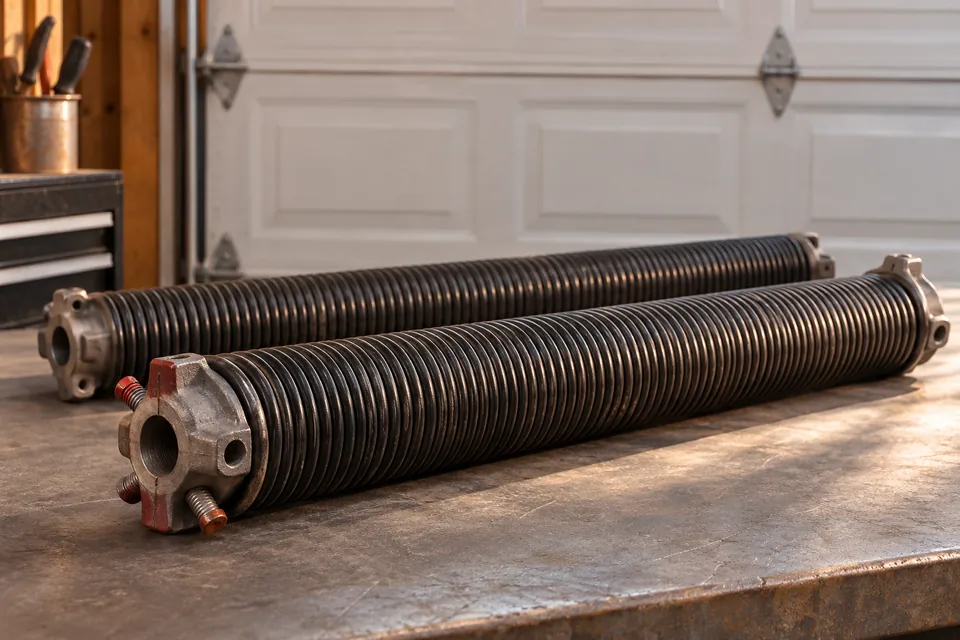
Have the technician identify the actual spring system and applicable door instructions. Clopay distinguishes its extension-spring containment cables from its torsion construction, where the spring surrounds a torsion shaft. An extension containment kit is not a universal addition to every counterbalance architecture. The illustrative torsion springs shown here do not identify the equipment in your garage.
Keeping extension springs and correcting containment is also different from converting the spring system. Missing containment alone does not establish a need to change architectures.
Compatibility includes the attachments and supports
Ask which manufacturer-supported containment kit fits the retained assembly and whether every extension spring is accounted for. Clopay's standard extension supplement identifies a separate containment kit, requires matching spring hardware and distinguishes arrangements with different spring counts. Those instructions illustrate why cable length, end fittings and associated hardware cannot be selected from appearance alone.
The assessment should include existing containment condition, intended attachment points, supporting hangers or brackets, and any corrosion, deformation or previous alteration that could affect the installation. Have the provider explain which supports can remain and which require correction. Do not assume spare lifting cable or a generic hardware-store cable is an approved substitute.
Agree on containment work and separate findings
A written scope should identify the kit, quantity, attachment or support repairs, removal of unsuitable existing containment, and professional completion checks under the applicable manuals. Ask how the technician will confirm that the finished installation suits the spring arrangement and does not interfere with door movement.
A broken spring still needs its own spring-replacement assessment; containment does not restore counterbalance. Have additional cable, spring or structural findings explained separately before authorizing them. Confirm the provider's exact-address coverage in Silver Spring, project total and warranty terms directly.
Questions for a containment-cable proposal
- Which spring architecture and manufacturer instructions were identified?
- Which containment kit and quantity fit every extension spring present?
- Are the intended attachments and supporting hardware sound or included for repair?
- What separate defects, completion checks and written warranty terms are documented?
Common questions
Does a containment cable stop an extension spring from breaking?
Its purpose is to help contain the broken spring, not prevent spring fatigue or restore lifting support. The spring and connected hardware still need professional assessment. Visible containment is not proof that the door is safe.
Can the cable already lifting the door serve as containment?
Do not assume it can. Lifting and containment cables serve different functions and have assembly-specific requirements. Ask the technician to identify each and specify approved parts for the retained system.
Should I open the door to show that a safety cable is missing?
No. Describe what you already noticed from a safe position and leave uncertain details for the technician. Do not operate, disconnect or reposition a suspect door to improve the view.
Read a little further.
Sources reviewed November 11, 2026. Follow the manual for your exact door and opener. These resources support general guidance, not a remote inspection.
- DASMA: Garage Door Safety Tips Calls for extension-spring safety cables and a professional safety inspection if absent; separately describes tension hazards in lifting cables and bottom brackets.
- Clopay: Standard Extension Spring Assembly Instructions Product-specific extension supplement identifies containment kits, matching hardware and different spring-count arrangements. Used for scope and compatibility, with installation and tensioning procedures omitted.
- Clopay: Garage Door Safety Checklist Distinguishes the manufacturer's extension-spring containment cables from torsion springs installed around a shaft; also identifies lifting-cable hazards.